


Hat Patch University
Vinyl Banner Cost in 2026: A Clear Pricing Guide

Custom vinyl banners typically run a range of prices for a single unit ordered online, depending on size, material, and finishing. A basic 2’x4’ banner in standard 13 oz vinyl with grommets is priced within a range at most online printers. Step up to a 3’x6’ and prices increase accordingly. A 4’x8’ in the same material generally has a moderate price range. Price per square foot on single orders generally varies and can decrease when ordering multiple units.
Before you lock in a budget, watch for these common extras that don’t always show up in the headline price:
- Design or file-setup fees may apply if your artwork isn’t print-ready.
- Proof charges may be billed separately for a digital proof.
- Finishing upgrades (pole pockets, reinforced corners, lamination)
- Rush production fees can increase the base unit price significantly.
- Expedited or oversized shipping can add substantial cost on large banners.
The vinyl banner pricing picture gets clearer once you understand exactly how vendors build a quote from the ground up.
Key Takeaways
Custom vinyl banner pricing depends on size, material weight, finishing choices, and turnaround time, and the delivered total is almost always higher than the headline unit price.
| Point | Details |
|---|---|
| Baseline price per sq ft | Single-unit online orders typically run $2.50–$5.00/sq ft; bulk orders of 5–10 units can cut that by 30–50%. |
| Add-ons to watch | File setup, proofs, pole pockets, lamination, and expedited shipping each add to the base price and are often not included by default. |
| Lead-time rule of thumb | Standard online production is 3–5 business days before shipping; rush production adds 25–50% to the unit cost. |
| When to upgrade materials | Choose 15–18 oz vinyl with lamination for long-term outdoor use; 13 oz is sufficient for single events or sheltered displays. |
| Hatpatchsupply advantage | Hatpatchsupply offers transparent, upfront quotes with fast fulfillment and no hidden finishing fees, making total cost predictable before you order. |
Table of Contents
- How do vendors calculate vinyl banner cost?
- What are typical prices by size and quantity?
- Which materials and finishes are worth the extra cost?
- How do production time, rush fees, and shipping change the total?
- Step-by-step checklist to estimate total cost and place an order
- Why order custom banners from Hatpatchsupply?
- How does the environment shorten banner life, and when do upgrades pay off?
- A practical perspective on banner spend
- Get a transparent quote from Hatpatchsupply
How do vendors calculate vinyl banner cost?
Size is the starting point. Most vendors price banners by the square foot, so a 4’x8’ (32 sq ft) costs roughly twice as much as a 2’x8’ (16 sq ft) at the same material grade. But square footage alone doesn’t tell the whole story.
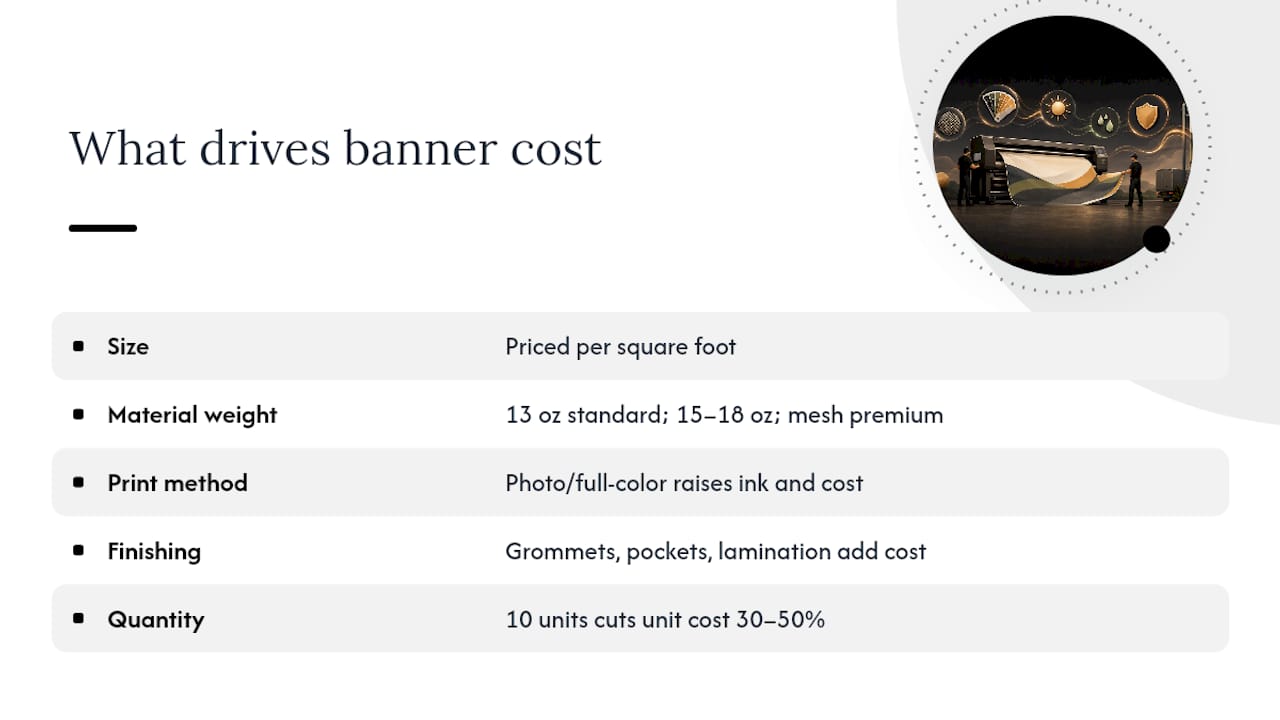
Material weight is the next major driver. Standard 13 oz scrim vinyl is the economy choice, widely available and adequate for short-term indoor or sheltered outdoor use. Heavier 15–18 oz blockout or industrial vinyl costs more per square foot but delivers better opacity, UV resistance, and tear strength. Mesh vinyl, designed to let wind pass through, typically carries a premium over standard 13 oz and is the right call for large outdoor banners in exposed locations.
Print method and resolution affect cost when you move from simple spot-color text to full-bleed photographic artwork. High-coverage, photo-quality prints use more ink and may require a higher-resolution output setting, which some vendors price separately. A banner with a full-color gradient background across 32 square feet will cost more to produce than the same size with black text on a white field.
Finishing choices stack onto the base price individually. Grommets (the metal eyelets used for rope or bungee hanging) are often included at standard spacing, but reinforced corners, pole pockets, double-sided printing, and lamination each add to the total. Wind slits, which are cut openings that reduce sail effect on large outdoor banners, are sometimes an add-on rather than a default.
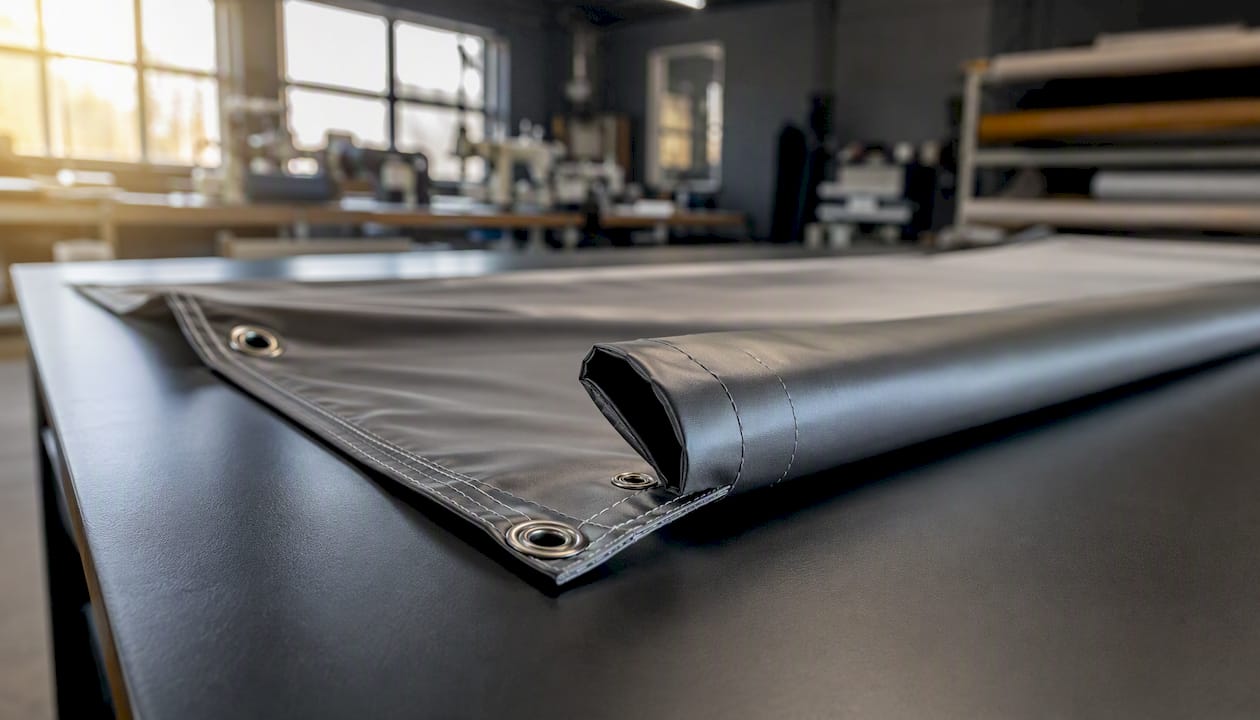
Quantity is where the economics shift most dramatically. Ordering ten banners of the same design typically cuts the per-unit cost by 30–50% compared with a single-unit order, because setup and cutting waste are spread across more pieces.
Pro Tip: Before requesting a quote, confirm your exact finished dimensions (not the design canvas size), specify your hanging method, and ask whether grommets are included by default or billed separately. Vendors who require you to specify bleed and trim lines upfront are usually the ones who won’t charge a surprise file-setup fee later.
What are typical prices by size and quantity?
The table below shows realistic price ranges for the most common banner sizes at single-unit and small-bulk quantities, based on standard 13 oz vinyl with basic finishing (grommets included). Local print shops tend to price closer to the high end of these ranges; online-only providers often land at the low end for standard orders.
| Size | Sq Ft | Single unit (online) | Single unit (local/retail) | 5–10 units (online, per unit) |
|---|---|---|---|---|
| 2’x4’ | 8 | $20 | $42 | $20 |
| 3’x6’ | 18 | $35 | $90 | $25–$42 |
| 4’x8’ | 32 | $90 | $112 | $42 |
Local pricing examples are drawn from posted small-run rates at regional print centers, where a 2’x3’ runs around $42 and a 2’x8’ around $112, with grommets as an optional finishing add-on.
A few notes on where a quote lands within these ranges:
- Low end: 13 oz vinyl, standard grommets, simple artwork, no rush, ground shipping
- Mid range: 15 oz vinyl or upgraded finishing (pole pocket, reinforced corners), standard turnaround
- High end: 15–18 oz vinyl, lamination, double-sided printing, or rush production with expedited shipping
Price per square foot works well as a bulk-order math tool, but it masks the fixed per-order costs (design setup, proof, and one-off finishing) that make single-unit pricing less favorable than ordering even a modest quantity of five or more.
Which materials and finishes are worth the extra cost?
Material choice is where most buyers either overspend or underinvest, and the right answer depends entirely on how long the banner needs to hold up and where it will hang.
13 oz scrim vinyl is the standard for a reason. It’s lightweight, easy to ship, and prints cleanly. For a one-time event, a trade show, or an indoor display, it’s the right call. Paying more for a heavier material on a banner that will be used once and stored is rarely justified.
15–18 oz blockout or industrial vinyl makes sense when the banner will stay outdoors for weeks or months. The heavier weave resists tearing in moderate wind, and the blockout layer prevents light bleed-through, which matters for double-sided applications or banners mounted against a lit background. The cost premium over 13 oz is typically $0.50–$1.50 per square foot.
Mesh vinyl is the right material for large banners in exposed outdoor locations, particularly on fences, scaffolding, or building facades where wind load is a real concern. The perforated surface reduces wind resistance significantly. Expect to pay a modest premium over standard 13 oz.
Common finishing options and when they matter:
- Grommets: Standard for most hanging applications. Usually included at 2-foot spacing; closer spacing adds cost but improves stability on large banners.
- Pole pockets: A sewn sleeve along one or both edges for a horizontal or vertical pole. Better than grommets for retail displays or trade show setups where you want a clean, wrinkle-free look.
- Reinforced corners: Adds durability at the stress points. Worth the small upcharge for any banner that will be re-hung multiple times.
- Lamination: Adds UV protection and scratch resistance. Justified for long-term outdoor use; unnecessary for a single event.
- Wind slits: Cut openings that reduce sail effect. Recommended for large banners (4’x8’ and up) in consistently windy locations.
- Double-sided printing: Roughly doubles the base print cost but eliminates the need for two separate banners when visibility from both sides matters.
Pro Tip: Match your finishing choice to your hanging method before ordering. If you’re using a banner stand or pole system, a pole pocket is cleaner and more secure than grommets. If you’re tying to a fence or railing, grommets with bungee cords are faster and more flexible. Ordering the wrong finish means either re-ordering or improvising on-site.
How do production time, rush fees, and shipping change the total?
The base unit price is rarely the number that matters most when you’re working against a deadline. Production timelines and shipping costs can easily add 30–60% to what looked like a competitive quote.
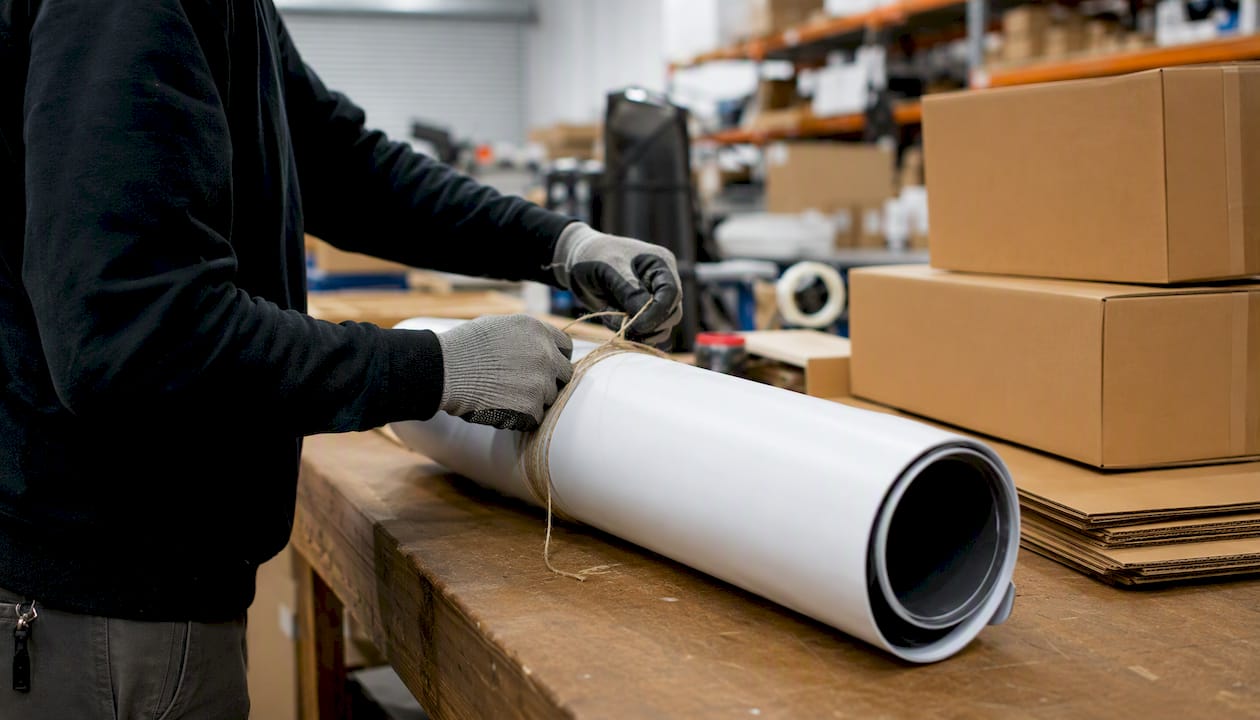
Standard production at most online banner printers runs 3–5 business days before the order ships. Add ground shipping (2–5 days depending on distance), and a banner ordered on a Monday might not arrive until the following week. For an event on a Saturday, that math only works if you order early.
Rush production, typically defined as 1–2 business day turnaround, carries a surcharge that varies by vendor but commonly adds 25–50% to the base unit price. Combine that with overnight or 2-day air shipping on a large banner, and the total delivered cost can exceed what a local print shop would charge for the same job with same-day or next-day production.
Same-day production at retail print centers is available but often comes with size and finishing limitations compared with dedicated online printers, which affects the trade-off for urgent orders. For complex or larger banners, online or specialized printers offer more options but require shipping lead time.
Hidden costs that commonly appear at checkout or on a final invoice:
- File setup or art charges: Triggered when artwork doesn’t meet the vendor’s specs (wrong resolution, missing bleed, incorrect color mode)
- Proof fees: Some vendors charge $10–$25 for a digital proof; others include it
- Lamination and specialty finishing: Usually listed as line-item add-ons
- Oversized shipping surcharges: Large rolled banners often trigger freight or dimensional-weight pricing
- Return shipping for revisions: If a proof is rejected and the banner is already printed, re-production and re-shipping costs fall on the buyer unless the vendor’s error policy covers it
Pro Tip: Always ask for a “landed total” before confirming an order. That means the unit price plus finishing, shipping, and any applicable taxes, all quoted together. A vendor quoting $0.89/sq ft may deliver a final invoice that’s 40% higher once shipping and finishing are added.
Step-by-step checklist to estimate total cost and place an order
Getting an accurate quote requires giving vendors complete information upfront. Missing one detail typically means a revised quote, a delay, or a surprise charge.
- Define the finished size and orientation. Confirm the exact dimensions in feet and inches, not the design file dimensions. Specify horizontal or vertical orientation.
- Choose your material. Decide between 13 oz (economy/short-term), 15–18 oz (durability/outdoor), or mesh (large/windy locations) before requesting a quote.
- Select finishing options. Specify grommets (and spacing), pole pockets, reinforced corners, lamination, or wind slits. Don’t leave these as defaults without confirming what the default actually includes.
- Prepare print-ready artwork. Most vendors require 100–150 dpi at full size, CMYK color mode, and a 0.25"–0.5" bleed beyond the trim line. Confirm the vendor’s exact specs before submitting.
- Decide on quantity and timeline. Ordering five or more units of the same design almost always reduces per-unit cost. Confirm your event or installation date and work backward from the vendor’s stated production and shipping time.
- Request a digital proof. A proof catches color, layout, and text errors before production. Ask whether the proof is included or billed separately.
- Confirm the shipping method and total. Ask for the landed total including shipping, finishing, and any applicable fees.
Questions worth asking every vendor before committing:
- Are grommets included in the base price, or are they an add-on?
- What file formats do you accept, and is there an art-setup fee if my file needs adjustment?
- What is the standard production time, and what does rush production cost?
- How is the banner shipped, and are there oversized or freight surcharges for large sizes?
- What is your policy if the printed banner doesn’t match the approved proof?
Comparing quotes on an apples-to-apples basis means specifying the same material weight, the same finishing, and the same turnaround and shipping terms for every vendor you contact. A quote that looks 20% cheaper may reflect a lighter material, excluded grommets, or slower shipping.
Why order custom banners from Hatpatchsupply?
Hatpatchsupply is built around one principle: you should know exactly what you’re paying for before you commit. Straightforward pricing and fast production times are the foundation of how we operate, which means no surprise art fees, no ambiguous finishing defaults, and no invoice that looks different from the quote.
Key reasons our customers come back for repeat banner and branding orders:
- Transparent quote process: Finishing options, material upgrades, and turnaround choices are presented clearly so you can build the order that fits your budget.
- Fast fulfillment: We prioritize quick production without sacrificing print quality, which matters when your event timeline is tight.
- Full-color, durable output: Our UV printing capabilities deliver vibrant, accurate color across the full print area, with finishing options matched to your display environment.
- Quality controls on every order: Each piece goes through a production check before it ships, reducing the risk of a reprint and the cost that comes with it.
- No-minimum flexibility: Whether you need one banner or twenty-five, we can accommodate the order without forcing you into a bulk commitment you don’t need.
Our product examples demonstrate the level of detail and color accuracy we bring to every custom branding order, from patches to full-size banners.
Pro Tip: When requesting a quote from Hatpatchsupply, include your finished size, intended hanging method, and whether the banner will be used indoors or outdoors. That single set of details lets us recommend the right material and finishing combination without a back-and-forth that delays your order.
How does the environment shorten banner life, and when do upgrades pay off?
Vendor longevity claims for standard vinyl banners typically state “up to 2 years” for outdoor use, but that figure assumes average conditions. In practice, UV exposure, wind, and humidity all shorten lifespan, and a banner installed in a high-UV, high-wind environment may degrade noticeably within a single season.
The practical lifespan ranges look roughly like this:
- 13 oz vinyl, sheltered outdoor or indoor: 1–2 years under average conditions
- 13 oz vinyl, direct sun and wind: 6–12 months before fading or edge fraying becomes visible
- 15–18 oz vinyl with lamination: 2–3 years in moderate outdoor conditions
- Mesh vinyl in high-wind locations: Comparable to 15–18 oz in longevity, with significantly less physical stress on grommets and mounting hardware
The upgrade math is straightforward. If a 13 oz banner costs $60 and lasts one season in a high-UV storefront location, you spend $120 over two years replacing it. A 15–18 oz laminated version of the same banner at $90 that lasts two full seasons costs less over the same period, and you avoid the labor and downtime of re-ordering and re-hanging.
Material and print technology choices also affect longevity. UV-resistant inks and lamination coatings slow the fading process on banners exposed to direct sunlight, which is why we apply the same attention to UV durability in our full-color printing process that we bring to our patch and branding products.
Pro Tip: Calculate cost per month of use, not just upfront price. A banner that costs 40% more but lasts twice as long in your specific environment is the cheaper option. Factor in re-hanging labor and any downtime if the banner is part of a permanent display.
A practical perspective on banner spend
The most common mistake we see is buyers optimizing for the lowest unit price without accounting for the delivered total or the actual use case. A $25 banner that arrives two days after your event, or fades after six weeks on a south-facing wall, isn’t a bargain.
We use three rules when advising customers on banner spend. First, match size to placement distance. A 2’x4’ banner is readable from about 20 feet; a 4’x8’ is designed for 40–60 feet of viewing distance. Ordering a large banner for a tight indoor space wastes money and creates a cluttered look. Second, don’t upgrade material unless the lifespan genuinely needs it. For a single event or a 30-day promotion, 13 oz vinyl is the right call. For a storefront that stays up through a full summer, 15–18 oz with lamination earns its cost. Third, always get the delivered total before committing. The unit price is a starting point, not the number that comes out of your budget.
For event use, the practical approach is to order standard 13 oz with grommets, plan for ground shipping with a week of lead time, and keep a digital copy of the approved artwork so re-ordering is fast. For long-term storefront signage, invest in the heavier material and lamination upfront, treat it as a capital expense rather than a consumable, and factor in one re-order every two to three years at most.
Get a transparent quote from Hat Patch Supply
Hat Patch Supply delivers custom banners with clear, upfront pricing and fast production so you can budget accurately and order with confidence. No hidden art fees, no ambiguous finishing defaults, and no invoice surprises at checkout. Our team handles full-color, durable banner production with the same quality controls we apply to every custom branding order we ship.
Ready to get started? Browse our custom UV printing capabilities to see the detail and color accuracy we bring to every order, then reach out with your size, material preference, and timeline. We’ll send you a complete quote that includes finishing, shipping, and production time so you know the full number before you commit.
Recommended
Ready to press your own?
Custom UV patches with no minimum, shipped in 72 hours — or grab a free-shipping sample pack first.