


Hat Patch University
Washable Hat Patches: Durable Materials and Wash Care

Yes, washable hat patches exist, and the strongest performers are UV-printed leatherette, PVC/rubber, tri-layer acrylic, and properly sewn or industrial-adhesive patches. Embroidered patches with dense stitching hold up well too, but the backing matters as much as the material. Here’s what we recommend before you place an order:
- Best durability and wash tolerance: UV-printed leatherette, PVC/rubber, and acrylic patches survive repeated wash cycles with minimal fading or edge lift.
- Main caveat: even a wash-tolerant patch fails early if the hat’s own structure, brim stiffness, mesh backing, or foam crown, can’t handle machine agitation.
- Next step: confirm wash instructions with your supplier before ordering, and always launder patched hats inside a mesh laundry bag on a gentle cycle. Hat Patch Supply publishes material specs on every product page so you can check this before you buy.
Key Takeaways
Durable, washable hat patches depend on matching the right material, UV-printed leatherette, PVC, acrylic, or embroidered, to a wash-resistant backing like sew-on or industrial adhesive.
| Point | Details |
|---|---|
| Material choice drives durability | UV-printed leatherette, PVC/rubber, and tri-layer acrylic tolerate repeated washing best. |
| Backing matters as much as material | Sew-on and industrial adhesive outperform Velcro and low-temp iron-on in wash cycles. |
| Wash gently, dry flat | Use cold water, a mesh laundry bag, and air drying; skip high-heat dryers entirely. |
| Test before you scale | Run a five-cycle wash test on a sample before committing to a bulk order. |
| Hat Patch Supply fits the brief | Offers UV-printed, acrylic, and adhesive-backed patches with no minimums and fast production. |
Table of Contents
- Which Hat Patch Materials Actually Survive Washing?
- Which Backings Hold Up Best in the Wash?
- How Do You Wash a Hat With a Patch on It?
- Which Patch Style Fits Which Hat Type?
- What Should You Ask a Supplier Before Ordering?
- How Fast Can You Get Custom Washable Patches Made?
- How Do Washable Patch Suppliers Compare on Quality and Guarantees?
- What Does a Washable Hat Patch Cost?
- Are There Durability Standards for Washable Patches?
- How Hat Patch Supply Builds Washable Patches That Last
- Frequently Asked Questions
- Sources
Which Hat Patch Materials Actually Survive Washing?
Not every patch material ages the same way in a washing machine, and the differences show up fast after three or four cycles. Embroidered patches use thick thread and raised stitching that resists abrasion when the edges are properly finished, according to Cap America’s guidance on embroidered patches for hats, though loose thread ends can fray if the merrowed border is thin. Woven patches offer finer detail on flat logos but their tighter thread count means less texture to hide wear over time.
PVC and rubber patches are essentially waterproof by design. Sealed edges resist cracking, and color rarely fades because it’s molded into the material rather than sitting on top of it. UV-printed leatherette, the format Hat Patch Supply specializes in, prints ink directly into a leatherette surface, which holds detail and vibrant color through wash cycles far better than heat-transfer vinyl. Acrylic patches, especially tri-layer acrylic builds, stay rigid and hold their shape because the layered construction resists the flex and twist that a washing machine applies to a floppier patch. Leather patches tolerate spot cleaning well but shrink or stiffen under water immersion and heat, so they’re better suited to wipe-down care than a wash cycle.
- Embroidered: durable stitching, but thread can fray at unfinished edges.
- Woven: fine detail, flatter surface, moderate wash tolerance.
- PVC/rubber: near-waterproof, color molded in, excellent for outdoor and work hats.
- UV-printed leatherette: vibrant, detailed, resists fading and cracking.
- Acrylic (tri-layer): rigid, shape-holding, strong for structured caps.
- Leather: best for spot cleaning only, not machine washing.
| Material | Wash Tolerance | Recommended Attachment | Best Use |
|---|---|---|---|
| Embroidered | High (finished edges) | Sew-on | Fashion caps, everyday wear |
| Woven | Moderate | Sew-on or iron-on | Detailed logos, low-wear hats |
| PVC/rubber | High | Sew-on or adhesive | Outdoor, work, marine hats |
| UV-printed leatherette | High | Adhesive or sew-on | Branded merch, workwear |
| Acrylic (tri-layer) | High | Sew-on or adhesive | Structured trucker/baseball caps |
| Leather | Low (hand clean only) | Sew-on | Rustic or vintage-style caps |
Ink type, adhesive formula, and edge finishing vary by producer, so two “UV-printed” patches from different suppliers can behave very differently after ten wash cycles. Ask what adhesive backing is used, whether edges are sealed, and how many wash cycles the manufacturer has actually tested against.
Which Backings Hold Up Best in the Wash?
Sewing and properly applied industrial adhesive deliver the most reliable wash performance. Removable Velcro and low-temperature iron-on backings work fine for occasional handling but degrade faster under repeated machine drying or hot water.
- Sew-on: the most durable option long-term, though it takes longer to apply and typically requires an embroidery machine or careful hand stitching.
- Heat-seal (iron-on): convenient for quick application, but Laughing Lizards notes that heat-applied bonds hold up better with hand-washing or a mesh laundry bag rather than a hot machine cycle.
- Pressure-sensitive adhesive (PSA): strong initial bond, good for smooth leatherette or acrylic surfaces, but can lose tack over many cycles if the adhesive formula isn’t rated for repeated washing.
- Durra Bull-style adhesives: a heavier-duty adhesive category built specifically for pre-cut leatherette patches, designed to outperform standard PSA in wash durability.
- Velcro/removable: convenient for swapping designs, but removable Velcro patch caps commonly list hand-wash only and air-dry instructions to protect the hook-and-loop bond.
Pro Tip: If you’re unsure whether your hat will see heavy washing, choose sew-on or industrial adhesive over Velcro. Removable systems are great for changing logos seasonally, but they’re the weakest link in a wash cycle.
Heat-press application generally runs in the range of 300 to 320°F, medium to firm pressure, and a 10 to 15 second dwell time, though exact settings vary by adhesive formula. Always confirm the manufacturer’s recommended temperature and dwell time before pressing, since overheating can degrade both the patch backing and the hat fabric underneath.
Choose sewing for hats that will see frequent commercial laundering, adhesive for a clean no-sew look on structured caps, and removable Velcro only when swap-ability matters more than wash longevity.
How Do You Wash a Hat With a Patch on It?
Hand-washing in cold water is the safest method for any patched hat, but a gentle machine cycle inside a mesh laundry bag works for most sewn, PVC, or UV-printed patches.
Hand-wash method:
- Pre-treat sweat stains or visible dirt with a soft brush and mild detergent.
- Submerge the hat in cold water with a small amount of gentle detergent.
- Gently agitate by hand for a minute or two, focusing on the sweatband, not the patch itself.
- Rinse thoroughly with cold water until suds are gone.
- Reshape the crown and brim by hand, then air dry on a hat form or rounded object.
Machine-wash method:
- Secure or remove any Velcro-backed patches before washing.
- Place the hat inside a mesh laundry bag.
- Wash on the gentle or delicate cycle with cold water and mild detergent, never bleach.
- Skip the dryer entirely; reshape and air dry instead.
| Method | Mechanical Stress | Water Temp | Drying Recommendation |
|---|---|---|---|
| Hand wash | Low | Cold | Air dry on hat form |
| Machine (mesh bag, gentle) | Moderate | Cold | Air dry, never tumble on high heat |
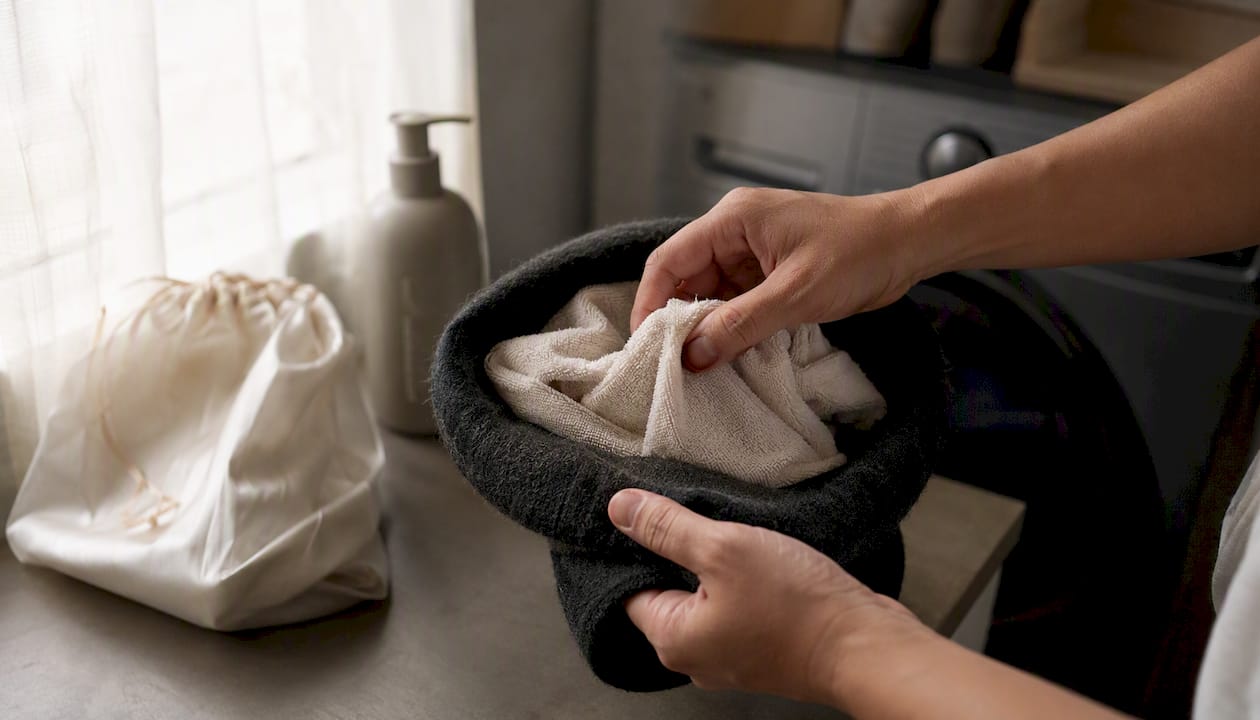
Pro Tip: Stuff the crown with a towel or hat form before washing to help it hold shape, and always skip high-heat drying. PuckFuel’s stain-removal guidance backs this up: heat is usually the real enemy, not water.
Which Patch Style Fits Which Hat Type?
Trucker hats have a foam front panel and mesh back, which makes adhesive or sew-on patches with a structured backing your best bet. Baseball caps offer more even fabric, so sewn, adhesive, or UV-printed patches all perform well. Beanies need sew-on or heat-seal patches rated for knit fabric, since a stiff acrylic patch will distort a stretchy crown. Straw hats are the exception: they’re often too delicate for machine washing at all, so treat any patch on straw as cosmetic-only and hand-clean or use a removable design.
- Trucker hats: center-front placement, maximum width around 3 to 3.5 inches, adhesive or sew-on.
- Baseball caps: center-front or slightly left of center, sew-on or UV-printed leatherette.
- Beanies: cuff placement only, sew-on or fabric-rated heat-seal, avoid rigid acrylic.
- Straw hats: hatband placement, removable or hand-clean only.
| Hat Type | Recommended Material | Recommended Backing |
|---|---|---|
| Trucker | UV-printed leatherette, PVC | Adhesive or sew-on |
| Baseball cap | Embroidered, acrylic, UV-printed | Sew-on or adhesive |
| Beanie | Woven, embroidered | Sew-on or fabric heat-seal |
| Straw | Leather, leatherette (cosmetic) | Removable or none |
What Should You Ask a Supplier Before Ordering?
Verify wash claims before you commit to a production run, not after 500 units show up with peeling edges.
- Ask for photos or video of the patch after five or more wash cycles, not just a fresh sample.
- Confirm the exact adhesive spec, PSA, Durra Bull-style, or heat-seal, and its rated wash tolerance.
- Ask about edge finishing and whether seams are sealed against water intrusion.
- Request recommended heat-press temperature, pressure, and dwell time in writing.
- Clarify lead times, minimum order quantities, and return policy for defective patches.
Order a small test batch or a single sample before scaling up. Hat Patch Supply supports this approach directly with no-minimum orders, so you can test a design on your actual hat before committing to hundreds of units.
Pro Tip: Run your own five-cycle wash test on a sample: gentle machine wash in a mesh bag, air dry, then inspect for adhesion, thread pull, or color fade before you approve a full production run.
How Fast Can You Get Custom Washable Patches Made?
Production speed and order minimums often decide which supplier gets your business, especially if you’re outfitting a launch or a seasonal drop. Traditional embroidery shops frequently impose minimum order quantities of 50 to 100 units per design because setup costs, digitizing a design, threading machines, need to be spread across a larger run to make economic sense.
UV-printing and laser engraving change that math. Because there’s no physical die or embroidery setup required, Hat Patch Supply offers no-minimum ordering alongside fast production times, which means a solo maker testing one design and a merch brand ordering 500 units both get the same turnaround advantage. That matters most when you’re validating a new hat style before a bigger commitment, or when a customer needs a single custom patch for a gift.
Lead time varies by patch complexity and order volume, but digital printing methods generally move faster through production than traditional stitching, since there’s no thread-color matching or machine setup between designs. If your timeline is tight, ask your supplier directly what their current production window looks like and whether rush options exist. A supplier that can’t give you a straight answer on turnaround before you order usually can’t give you one after, either.
How Do Washable Patch Suppliers Compare on Quality and Guarantees?
Supplier quality in this category comes down to three things: what materials they actually specialize in, whether they stand behind wash durability, and what real buyers say after using the product for months, not just after unboxing it.
Generic patch marketplaces often carry a wide catalog spanning embroidery, PVC, and printed options, but breadth doesn’t always mean depth in any one method. GS-JJ’s product notes point out that durability depends heavily on material and backing choice, and many general sellers advise spot-cleaning over machine washing as a safe default, a sign that their processes aren’t necessarily built to survive repeated laundering.
Specialization tends to produce better wash outcomes. Hat Patch Supply focuses specifically on UV-printed and laser-engraved leatherette patches rather than trying to be everything to everyone, and that focus shows up in consistent production quality and published customer satisfaction rates. When a supplier narrows its offering to methods it can control closely, ink formulation, adhesive selection, edge sealing, wash performance tends to be more predictable than with a shop juggling a dozen different production methods at once.
Look for suppliers who publish real wash-care instructions on the product page itself, not buried in a separate FAQ, and who are transparent about what their patches can and can’t tolerate.
What Does a Washable Hat Patch Cost?
Price scales with material complexity and order volume, and the gap between options is wider than most first-time buyers expect. Embroidered patches typically cost more per unit at low volumes because of setup and thread costs, though the price per patch drops significantly at higher quantities. UV-printed leatherette and PVC patches often sit in a more accessible range at low volumes since there’s no embroidery setup fee, making them a practical entry point for makers testing a single design.
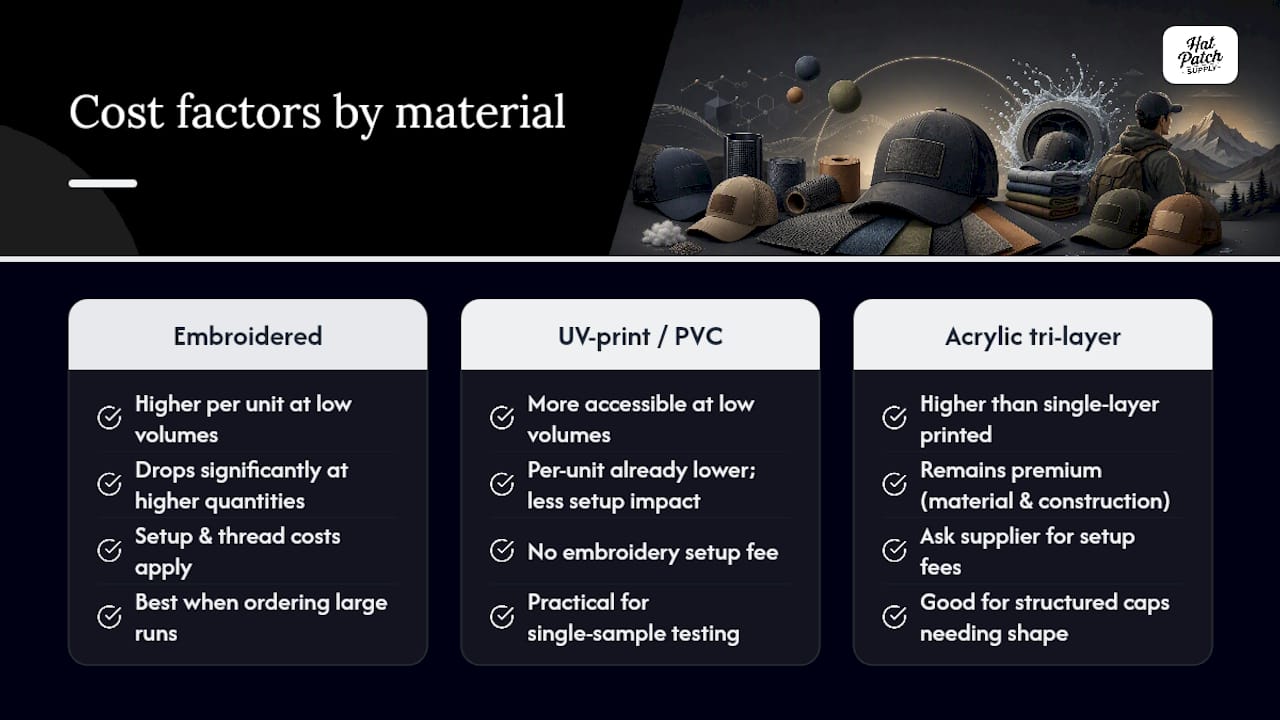
Acrylic tri-layer patches cost more than a single-layer printed patch because of the added material and construction, but the rigidity and shape retention often justify the premium for structured caps that need a patch to hold its form through repeated wear and washing.
Minimum order quantities move the real cost conversation more than per-unit price does. A supplier requiring 100 units minimum forces you to commit before you know if a design works, while no-minimum ordering lets you order exactly what you need, whether that’s a single sample or a full production run. For small brands and individual makers, that flexibility often matters more than shaving a few cents off the per-unit price.
Always ask for a quote broken out by material, quantity tier, and any setup fees before comparing suppliers side by side. A low headline price with hidden setup costs isn’t actually the better deal.
Are There Durability Standards for Washable Patches?
There’s no single industry-wide certification that guarantees a patch will survive washing, which is exactly why buyer-side testing matters more than a supplier’s marketing claims. The most useful benchmark available to buyers right now is a simple, repeatable protocol: run a patched sample through five gentle machine wash cycles in a mesh bag, air dry between cycles, then inspect for adhesion loss, color fade, or edge lift.
That kind of test doesn’t require a lab. It requires a washing machine, a sample patch, and the discipline to actually check the result before placing a bulk order. Ask any supplier whether they’ve run this kind of cycle test on their own products and whether they can share documentation or photos. A supplier confident in their materials will usually have this information ready; one that dodges the question is telling you something too.
Material-specific signals matter as well. Sealed edges resist water intrusion better than raw-cut edges. Ink that’s embedded into leatherette rather than surface-printed resists fading longer. Stitching density on embroidered patches correlates directly with abrasion resistance. None of these are formal certifications, but together they function as a practical durability checklist you can apply to any supplier’s product line before you commit to a production run.
A Patch Maker’s Take on Real-World Wash Performance
UV-printed leatherette and properly sewn embroidery hold up best over time, mostly because the failure points, adhesive creep, thread pull, edge peeling, show up slowest in those two formats. Adhesive creep is the quiet killer: it doesn’t show up in wash one or two, but by cycle five or six a corner starts lifting, especially on cheaper PSA. Sealed edges and a wash-tested adhesive formula solve most of this before it starts.
How Hat Patch Supply Builds Washable Patches That Last
Every recommendation in this guide, UV-printed leatherette for vibrant durability, tri-layer acrylic for structure, adhesive backing for clean application, maps directly onto what Hat Patch Supply actually produces.
If you need a patch built for outdoor or jobsite conditions, the In The Dirt UV Printed Patch shows how UV printing holds color and detail through repeated wear. For workwear branding, the Forklift Certified UV Printed Hat Patch demonstrates the same durable printing process applied to a certification-style design. And if your hat needs a patch that holds its shape through washing and everyday handling, Custom Tri-Layer Acrylic Patches deliver the rigid, layered construction this guide recommends for structured caps.
No minimum order requirements mean you can test any of these formats on a single hat before committing to a production run, and production moves fast enough that you’re not waiting weeks to find out if a design works. Ready to see how your logo looks on a real patch? Browse the full color UV-printed patch options and order a sample today.
Frequently Asked Questions
Are washable hat patches actually machine washable, or hand wash only? It depends on the material and backing. UV-printed leatherette, PVC, and sewn patches generally tolerate a gentle machine cycle inside a mesh laundry bag, while Velcro and delicate leather patches usually call for hand washing only.
What’s the most durable hat patch material for frequent washing? UV-printed leatherette, PVC/rubber, and tri-layer acrylic tend to outperform other materials because their color and structure aren’t dependent on surface coatings that can peel or crack.
Can I remove a patch before washing and reattach it later? Yes, if it’s a Velcro or other removable system. Removing the patch before washing protects both the hook-and-loop bond and the hat fabric underneath.
How many wash cycles should a good hat patch survive? There’s no universal standard, but a common buyer-side benchmark is five gentle machine cycles with visual and adhesion inspection afterward to confirm the patch still holds securely.
Do embroidered patches hold up as well as printed patches in the wash? Embroidered patches with dense, properly finished stitching can be just as durable as printed options, though thin or unfinished thread edges are more prone to fraying over time.
Sources
- How to Decorate Hats With Iron on Patches – Laughing Lizards
- Removable Velcro Patch Cap — BNSFStore product page
Recommended
- In The Dirt UV Printed Patch - Durable and Stylish Design – Hat Patch Supply
- Hat Patch Making Made Simple: 7 Powerful Tips to Create Custom Hats That Stand Out - Hat Patch Supply by Hat Foundry
- Forklift Certified UV Printed Hat Patch - Durable & Stylish – Hat Patch Supply
- Custom Pimpin UV Printed Patch - Durable and Vibrant Design – Hat Patch Supply
Ready to press your own?
Custom UV patches with no minimum, shipped in 72 hours — or grab a free-shipping sample pack first.